What 'Windproof' Means: Double Canopies and the Level 8 Wind Test
How vented double canopies and fibreglass ribs help umbrellas survive gusts, what a level 8 wind test means on the Beaufort scale, and what to ask suppliers.
Vom Team von Lotus Umbrella7 Min. Lesezeit
A windproof umbrella is built to ride out strong gusts without breaking. Most designs do it in two ways: a vented double canopy that lets trapped air escape, and flexible ribs, usually fibreglass, that bend under load and spring back. Because no single regulation defines "windproof", the real evidence is a wind test that states the wind speed, the method and the laboratory.
This guide explains how those features work, what a "level 8" result means on the Beaufort scale, and what to ask a supplier before the word goes on your packaging.
Why umbrellas fail in strong wind
An open canopy behaves like a sail. A gust from below or from the side pushes it upwards, and if the pressure is high enough the canopy turns inside out. As it inverts, the load concentrates on a few small parts: the rib joints, the runner that slides up the shaft, and the short stretchers that connect the ribs to the runner.
Failures follow a familiar pattern. Steel ribs bend and stay bent, plastic joints crack, rivets pull through and the fabric tears away from the rib tips. Gusts do more damage than steady wind because the load changes suddenly, so a frame that copes with a constant breeze can still fail in a squall.
How a vented double canopy works
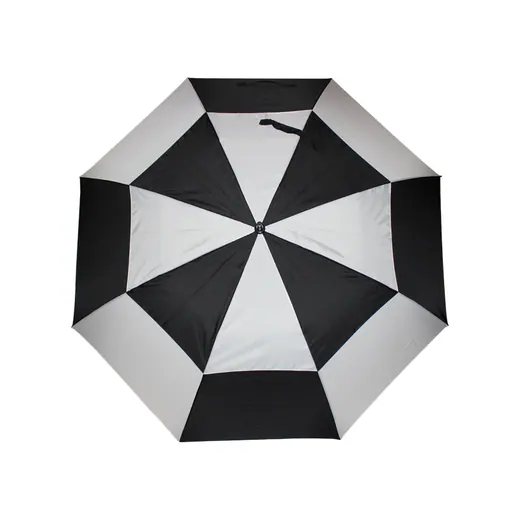
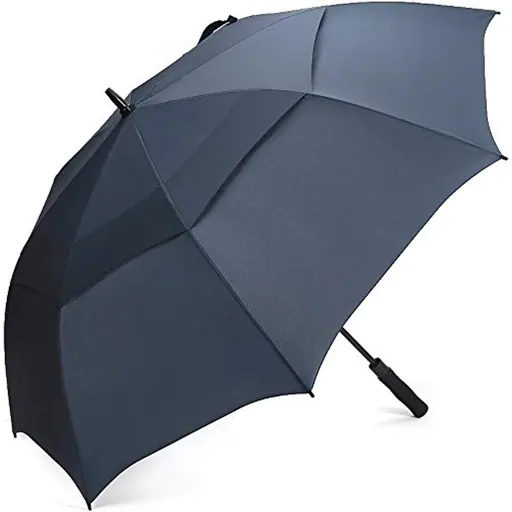
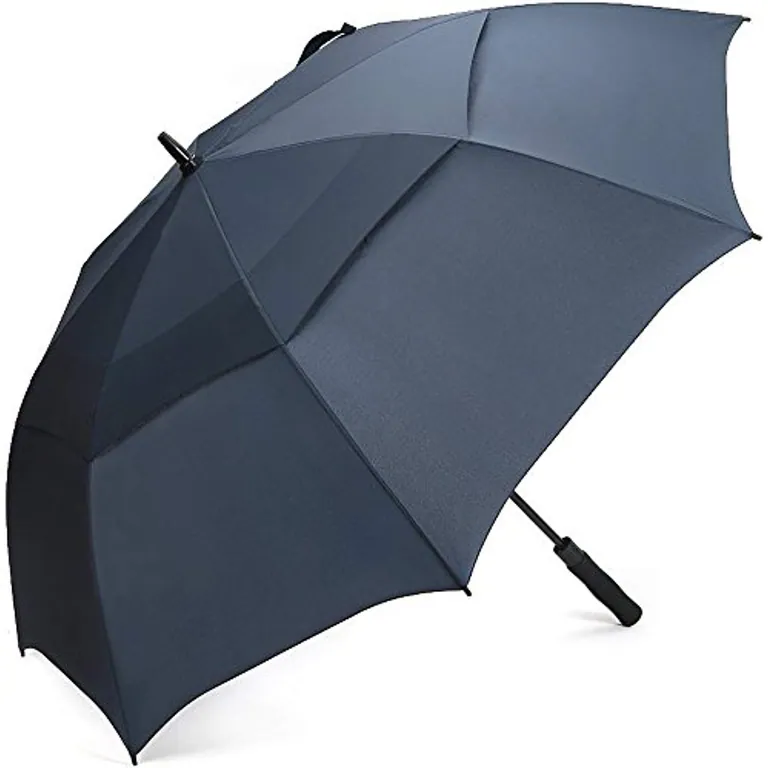
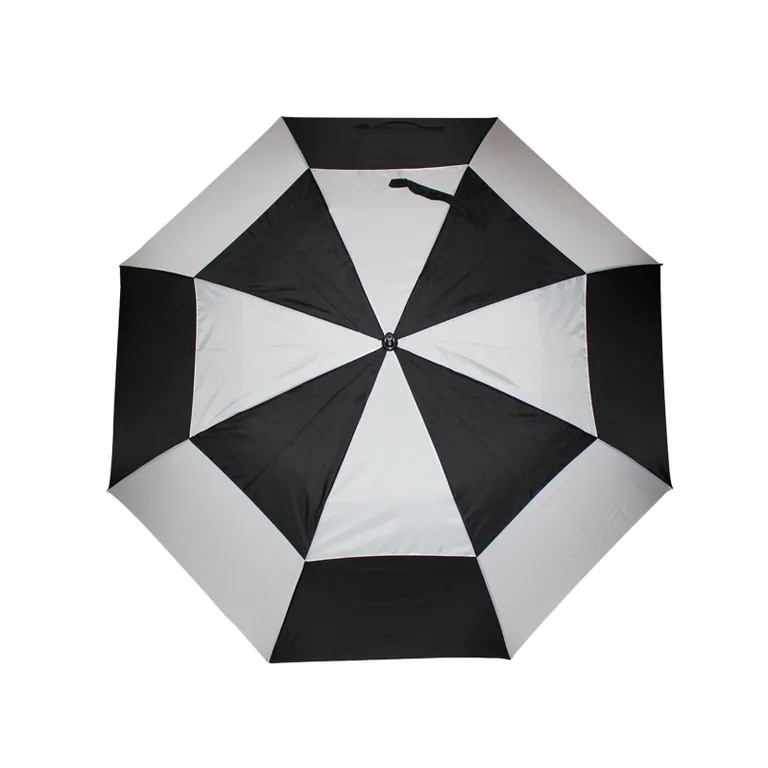
A double canopy has two layers of fabric at the crown. The lower layer has an opening, and the upper layer covers it with a gap around its edge. When a gust builds pressure under the umbrella, the upper layer lifts, air escapes through the vent, and the layer settles back to keep the rain out.
Releasing that pressure reduces the lift that turns a canopy inside out and lowers the peak load on the ribs, which can also make the umbrella steadier to hold. The trade-offs are modest: a little more fabric, a little more weight and a higher unit cost. For promotional work, the upper layer can be made in a contrast colour, which adds a design element without any extra printing.
Double canopies are common on golf umbrellas, where the large canopy catches the most wind, and they are also available on compact folding models.
Flexible ribs: fibreglass, steel and aluminium
The ribs decide what happens when the canopy is overloaded. Fibreglass ribs flex under a gust, return to shape when the load passes, and do not rust. Plain steel ribs are stiff and economical, but once they are bent past their limit they stay bent. Aluminium is light, which suits travel umbrellas, but it is softer than steel and deforms more easily.
Many wind-resistant folding frames combine a metal shaft with fibreglass ribs, particularly in the outer sections that move the most. Rib count matters too: 8 ribs is the common standard, while 16 or 24 ribs spread the load across more points at the cost of weight and price. Our guide to fibreglass, steel and aluminium frames covers the materials in more detail.
| Feature | What it does in strong wind | Trade-off |
|---|---|---|
| Vented double canopy | Lets air escape, reducing lift and the risk of inversion | More fabric, slightly heavier, higher cost |
| Fibreglass ribs | Flex under gusts and return to shape | Cost more than plain steel |
| Steel ribs | Stiff and economical | Bend permanently once overloaded |
| 16 or 24 ribs | Spread the load across more points | Heavier and more expensive |
| Reinforced joints and runner | Strengthen the usual points of failure | Small increase in cost |
| Larger canopy | Covers more people and equipment | Catches more wind, so it needs a stronger frame |
The Beaufort scale and what "level 8" means
The Beaufort scale describes wind strength as numbered forces from 0 (calm) to 12 (hurricane force), based on the mean wind speed at a standard height of 10 metres. Chinese laboratories and factories use the same scale and call each force a "level", so a "level 8 wind test" is a test at Beaufort force 8.
Force 8 is a gale: roughly 62–74 km/h, or about 39–46 mph. The figures below are approximate, and gusts in the same conditions can be considerably stronger than the mean speed.
| Force | Description | Approx. km/h | Approx. mph | Typical signs on land |
|---|---|---|---|---|
| 5 | Fresh breeze | 29–38 | 19–24 | Small trees in leaf begin to sway |
| 6 | Strong breeze | 39–49 | 25–31 | Large branches move; umbrellas used with difficulty |
| 7 | Near gale | 50–61 | 32–38 | Whole trees in motion; walking into the wind is hard |
| 8 | Gale | 62–74 | 39–46 | Twigs break off trees; progress on foot is impeded |
| 9 | Strong gale | 75–88 | 47–54 | Slight structural damage, such as loose roof tiles |
The traditional description of force 6 already includes "umbrellas used with difficulty", which is why a pass two levels higher is a meaningful result for a hand-held umbrella.
What a wind test involves
Methods vary between laboratories and buyers, but a typical test fixes an open umbrella in front of a wind tunnel or a high-powered fan. The air speed is raised to the target level, checked with an anemometer and held for a set time. Some protocols turn the umbrella so the wind strikes it from different angles, including from below, where inversion is most likely.
Afterwards the umbrella is inspected. Typical pass criteria include no broken ribs, stretchers or joints, no torn or detached fabric, and normal opening and closing. Some methods accept a canopy that inverts, provided it can be returned to shape without damage. Because these details differ, two "level 8" claims are not always comparable. When a supplier quotes a wind result, ask for:
- the test report, with the laboratory's name and the test date
- the model, size and frame specification that was tested
- the wind speed in m/s or km/h, not only the level
- the duration, the angles tested and the number of samples
- the pass criteria that were applied
Lotus and wind resistance testing
Lotus had a level 8 wind resistance test carried out by an independent laboratory, RTS, in February 2026. Wind resistance is also one of the points checked at final inspection, together with waterproofing, UV coating and finish, using AQL 2.5 sampling before packing. Our quality and inspection page explains the full three-stage process. If your customer needs a report for a particular model, ask the sales team what is available for it.
Choosing and describing a wind-resistant umbrella
No umbrella is unbreakable. A strong gust, a sudden change of direction or a canopy held at the wrong angle can overload any frame, and a laboratory pass describes performance under test conditions rather than a guarantee in every storm. It is therefore safer to state the tested level, for example "tested to Beaufort force 8 in a laboratory test", than to promise that an umbrella cannot break, and to keep the report on file to support the claim.
Match the construction to the use. For golf days, sports sponsorship and outdoor events, a 30-inch vented double canopy on a fibreglass frame is a common choice, and our guide to golf umbrella sizes helps with canopy size. For commuters and travel, a compact folding umbrella with fibreglass ribs keeps the weight down. You can compare models in our large and golf umbrella range, or start from a specific model such as the vented windproof golf umbrella with logo printing, which lists an MOQ of 100 pcs.
If you are planning a wind-resistant umbrella for your brand, send an inquiry with the size, quantity and use you have in mind. The sales team replies within 24 hours and can arrange samples, so you can check the frame and canopy yourself before you order.
Häufig gestellte Fragen
Is a double canopy umbrella always stronger than a single canopy?
Not automatically. The vent relieves pressure on the canopy, but overall strength also depends on the rib material, the joints and the canopy size, so compare complete frames and test results rather than the canopy alone.
How strong is the wind in a Beaufort level 8 test?
Level 8 is a gale, with mean wind speeds of roughly 17 to 21 metres per second. Real gusts in those conditions can be stronger, which is why test results describe laboratory performance rather than a guarantee.
Can I print 'windproof' on my retail packaging?
Only claim what you can support. Stating the tested wind level and keeping the laboratory report on file is the safer approach, and you should check the rules on product claims in your market.
Is wind resistance checked on bulk orders as well as on samples?
At Lotus, wind resistance is one of the checks in the final AQL 2.5 inspection before packing. If your customer needs independent testing of your production, discuss it with the sales team when you order.